Counts you can audit, not numbers you have to trust
Let us say it plainly at the top, because it shapes everything about this service: we count, we mark up, and we stop there. We do not put dollars on your bid. Your labor rates, your supplier pricing, your crew's speed and your overhead are things only your firm knows, and an estimate built on a stranger's rates is worse than no estimate at all. What your estimator needs from a takeoff service is the one thing that eats bid-week hours: accurate quantities, gathered fast, in a form that can be checked.
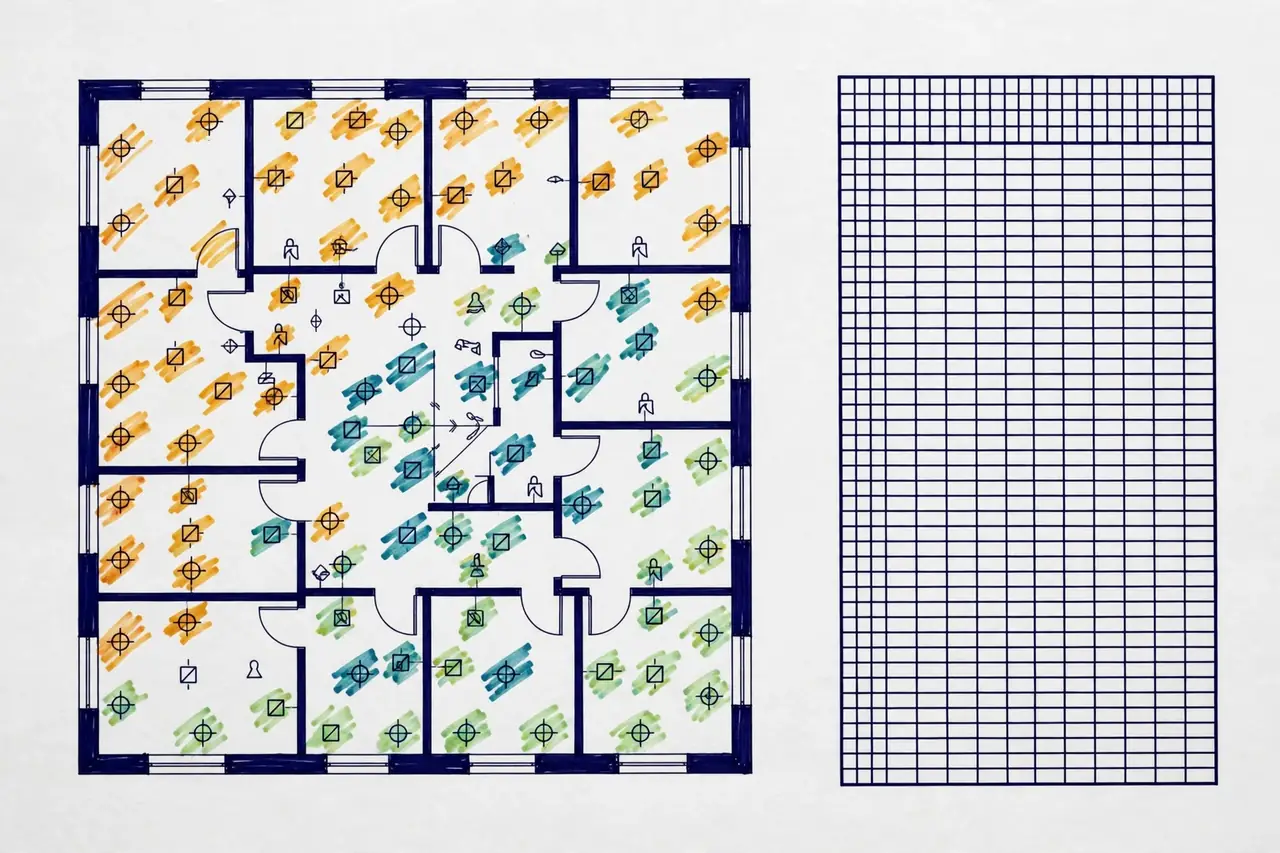
That is what we deliver. Every device, fixture and run on your plans gets counted and marked. The count sheets break totals down by area and by system, so a ground-floor lighting count never hides inside a whole-building number. And every total ties back to marks on the plan itself — if your estimator wants to verify the receptacle count in one wing, the marks are right there, item by item.
Bid deadlines do not move. With our overnight workflow, plans sent by your US evening come back counted by the next US morning, which gives your estimator the pricing time instead of the counting time. That swap — your hours on rates and strategy, our hours on counts — is the whole point of the service.

Sample: takeoff markup — counted plan sheet
What is included in a takeoff
Counts follow the symbols, legends and schedules on your plans. Where a plan is unclear, we list a question — we never guess a count into your bid.
What we count
- Devices: receptacles, switches, data and specialty outlets, by type
- Lighting fixtures by type, matched to your fixture schedule
- Panels, switchgear and distribution equipment shown on the plans
- Conduit runs by size, with lengths measured from the plans
- Wire and feeder quantities where the single-line diagram defines them
- Fire alarm, low-voltage and other systems when you put them in scope
- Alternates, add options and phased areas counted separately, on request
- A questions list for anything the plans leave unclear — no silent guesses
How the counts come back
Counts are done in Bluebeam Revu, with a mark placed on every counted item, color-coded by system or device type. The count sheets mirror those marks: one row per item type, split by area and system, with totals your estimator can drop straight into a bid spreadsheet.
Because the marks and the sheets are built together, the audit trail is simple. Pick any row, find its color on the plan, and count the marks yourself in a minute or two. Estimators tell us this check is what makes an outside takeoff safe to bid from — the first project usually gets spot-checked hard, and the markup holds up.

Sample: delivery review — count sheets and markups
Built for the same buyer as our drafting work
If you already send us drafting, the takeoff fits the same workflow: same WhatsApp line, same fixed-quote-first rule, same overnight rhythm. Many contractors pair the two — takeoff counts for the bid, then drafting for the job after award. The counts from the bid set carry forward, so panel and conduit quantities your estimator already checked become the starting point for schedules and layouts.
The reverse works too. A takeoff on a set we have never seen often turns into a drafting relationship, because the questions list we send back — missing schedules, unclear symbols, a feeder with no size — is the same gap check we run before drafting a set. Either way, you get one studio that knows your templates, your symbol legend and how your estimator likes a count sheet laid out.
Scope honesty matters here as much as anywhere. Drafting only — no PE stamp. Final review and stamp remain with your licensed engineer. A takeoff is a count of what the plans show; it is not engineering, and it is not a bid. Your firm owns the price, the risk calls and the final number, exactly as it should be.
What we need from you
- The full bid plan set — floor plans, power and lighting plans, schedules
- The single-line diagram, if feeders and distribution are in scope
- Your bid deadline, so we can confirm the turnaround in writing
- A scope note: which systems and areas are in, which are out
- Alternates or phased areas that need separate counts
- Your count sheet format, if your estimator works from a house template
PDF plans are fine. If the set is large, send a download link — we will confirm receipt and the fixed quote before the clock starts.
Fixed per-project pricing
Takeoffs start from $95 per project, and every project is quoted as one fixed price before counting begins. The quote turns on plan size and scope — sheet count, systems included, alternates — never on the value of the bid or how it turns out. There is no percentage fee and no per-hour meter.
Turnaround is confirmed with the quote and built around your deadline. Standard delivery runs 24–48 hours for most bid sets, and overnight delivery covers the common case: plans in by your evening, counts in your inbox the next morning, with the marked-up plans and count sheets together so your estimator can start pricing right away.
Need counts every bid week? Contractors who bid often set up a standing pattern with us — same scope note style, same count sheet format, same markup colors — so each new set comes back in a form your estimator already knows. The first project still starts with a fixed quote confirmed in writing, like every job we take.
How a takeoff runs
Four steps, timed around your bid deadline.
Send the bid set
Message us the plan set, schedules and your deadline on WhatsApp, with a short scope note on what is in and what is out.
Fixed price confirmed
One fixed per-project price, confirmed in writing before counting starts. The number never depends on your bid value or the result.
We count and mark up
Every device, fixture and run is counted in Bluebeam Revu and marked on the plans by color, with unclear items listed as questions, not guesses.
Count sheets delivered
Counts arrive by area and system, tied line by line to the plan marks, so your estimator can audit any total and start pricing right away.
A note on rush bids: if a deadline lands before a full takeoff can finish, tell us which areas or systems matter most. We can count the high-value scope first — feeders, gear, fixtures — and follow with the balance, so your estimator is never sitting idle waiting for a single delivery. What we will not do is rush by skipping the markup. A fast count you cannot check is a risk priced into your bid, and that trade is never worth it.
Related services
Takeoffs pair naturally with the drafting services your bid turns into after award.
Takeoff questions
What does an electrical takeoff include?
A takeoff includes counts of devices, receptacles, switches, fixtures by type, panels, and conduit and wire runs by size, organized in count sheets by area and system. You also get the marked-up plans showing every counted item, so the numbers are easy to trace. Counts follow the symbols and schedules on your plans, and anything unclear is listed as a question instead of being guessed.
Is your takeoff service quantities only, or do you price jobs?
Quantities only — and that is deliberate. We count and mark up; you price the job. Your labor rates, material pricing, supplier deals, and overhead are your business, and a bid built on someone else's rates is a bid you cannot trust. We hand your estimator clean, auditable counts, and your team applies the numbers only your firm knows. That split keeps the bid fully in your control.
What plans do you need to start a takeoff?
Send the full plan set for the bid: floor plans, power and lighting plans, panel schedules, fixture schedules, and the single-line diagram if the job has feeders to count. PDF is fine. Tell us the bid deadline, any alternates or phased areas to count separately, and which systems are in or out of scope. The clearer the scope note, the cleaner the count sheets come back.
How do you mark up counts so we can check them?
Every counted item gets a mark on the plan in Bluebeam Revu, color-coded by system or device type, and the mark totals tie to the count sheets line by line. Your estimator can click from a count sheet row back to the marks behind it and audit any number in minutes. If a count looks off, the markup shows exactly what was counted and where.
Can you do takeoffs on a fixed per-project price?
Yes. Takeoffs start from $95 per project, and every job is quoted as one fixed per-project price confirmed in writing before we start counting. The quote depends on plan size and how many systems are in scope, not on how the bid turns out. There is no percentage of bid value and no surprise add-ons — you know the full cost before the deadline pressure starts.
Bid day is close. Get the counting off your desk.
Send your bid plans tonight and get auditable counts back on a fixed per-project price — then spend your hours on the pricing only your firm can do.